

Deeper Into the Southern Border Crisis.
Deeper Into the Problem
ATP Update on the US Southern Border Migrant Crisis.
All Things Possible Ministries has been looking for ways to alleviate some of the suffering that is involved with the migrant crisis. We want to help defend our borders while simultaneously protecting the vulnerable women and children that are trapped in the middle of this disaster. We went deeper into this problem and traveled to Mexico, Guatemala, Panama, and Colombia to experience key points along this migrant journey for ourselves. It is worse than we even imagined. We’ve determined where we will weight our efforts and will continue to update everyone as we embark on establishing some new operational areas for ATP.
The Problem as We Outlined it Previously:.
Problems.
Drug use in the US is fueling this crisis. Drug consumption in the US continues to skyrocket.. There is nothing we can do about this. America is too wealthy, apathetic, and spoiled to even consider getting off their addictions. America is too content to live in this sinful consumption. This is too big for ATP to try to fix. Prayer is the answer.
The Mexican Drug Cartels are more than happy to feed the demand.. Neither the US Government not the Mexican Government want to truly tackle the cartels and continue to offer them free reign in both countries. This is too big for ATP to try to fix. Prayer is the answer.
The Biden Administration continues to obfuscate the situation and is completely culpable in the rise of migrants that are subject to extortion, rape, and violence along their journey.. The Biden Administration continues to lock down the resources needed to alleviate this crisis. Our government, and the general population of the US do not care enough about this crisis to make any significant changes. The political polarization of the US only creates more space for this disaster to grow. This is too big for ATP to try to fix. Prayer is the answer.
Many of the migrants have been claiming asylum but the situations that they are leaving do not meet the requirements for asylum. With current events in Haiti, Cuba, and Venezuela, there may be more credence for asylum claims for migrants coming from those countries. This will only exacerbate things and provide more cover for the cartels to move drugs. We’ve identified some choke points along the migrant path where we believe that we can assist. ATP can help one woman, one child, and one family at a time. Your prayers are appreciated.
The Problem as We See it Today.
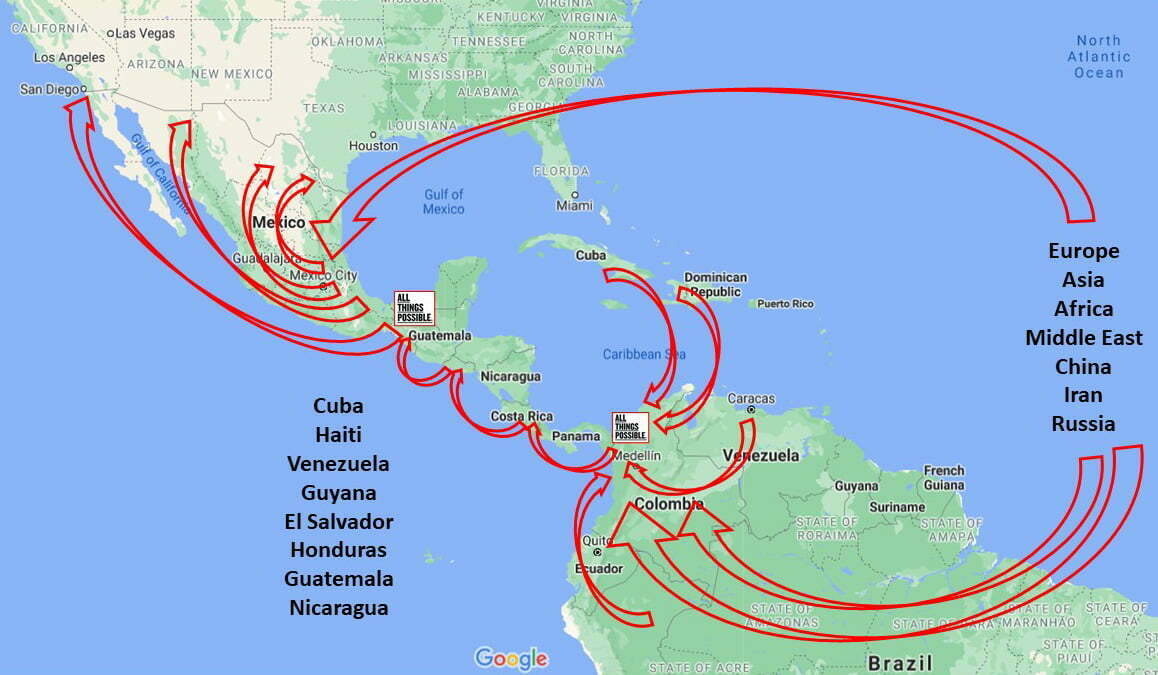
There is no stopping the current flow of migrants. They are already in the pipeline, and they are coming.
There are a couple of points along the migrant journey where they are held up for months. At these points, they can be sheltered, trained, educated, and equipped, and encouraged to stay where they are or return to their country of origin. If they decide to continue to head toward the US, they will at least have some language skills and other occupational training to help them become productive citizens.
WARNING!
The numbers that we have been seeing on the US Southern Border are about to explode in the next few months. Most, if not all, of the migrant reporting in the US focuses on the final 100 meters of the journey- crossing into the US. But this migrant journey starts months and years prior to them crossing our southern border. ATP went “upstream” and saw firsthand what is coming our way. On this trip, our lead guide was ATP Ambassador and war correspondent Chuck Holton and we also linked up with war correspondent Michael Yon for our expedition into the Darien Gap. Other than our team, we never saw another American, westerner, or even white person on our entire trip in Central America. Michael and Chuck helped us become familiar with the term “weaponized migration” or “refugees as weapons”. This is a concept we see happening around the globe and we want to warn you that it is happening right on our shores.
Refugees as Weapons or Weaponized Migration.
Weaponized migration is a term used for organized mass exodus of refugees and migrants from one state to another state as a “weapon” against that ‘targeted’ state.
Weaponized migration occurs when a challenging state or non-state actor exploits human migration—whether voluntary or forced—in order to achieve political, military, and/or economic objectives. Strategically engineered migration is far more common than most people realize. At any given time, somewhere in the world, leaders inside or outside governments are likely manipulating migrants and/or refugees to pursue political, military, or economic objectives. When governments or others “weaponize migration,” they manipulate or exploit the movement of people- or threaten to do so- to achieve a strategic objective. Often, the “humanitarian support” for this migration can be a cover for action as agendas are being met to chip away at another nations’ stability.
The objective is to economically cripple the United States and develop friction, fractures, and fissures in our national populace. State actors like Iran, Venezuela and China want to see us crippled. Non state actors like Drug Cartels, the Taliban, ISIS and Al Qaida want to see us fall.
The long term effects of this migrant crisis are existential for the United States. As huge numbers of people come in, they’re automatically going to ghettoize, and the economic strain will be severe. If we bring large numbers of people from other cultures that aren’t ready for our culture, or they can’t assimilate into our culture because they are illegally here, they’re not going to automatically get absorbed. They’re going to form insular human islands that have their own forms of rules, laws, and customs. These are the things that enemies can use later, and are using currently, to split people apart. They want to cause people to fight each other.
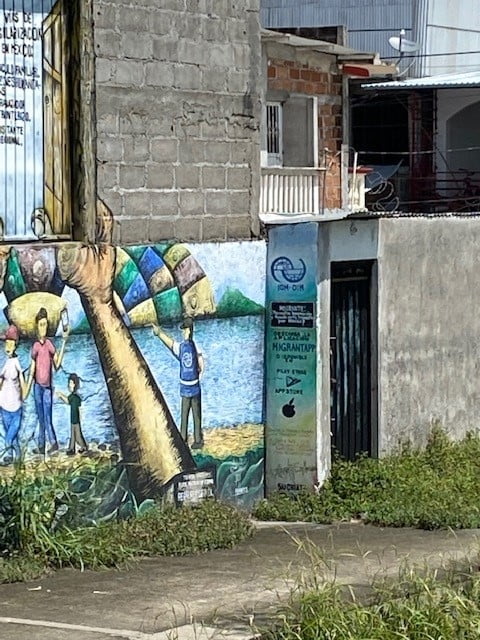
This photo is a mural painted on a wall on the Mexico side of the Guatemala / Mexico border guiding migrants to an App they can download to assist them in their plight.
Does this sound too farfetched to you? Is it any different than what we are seeing politically and socially in America right now and with Antifa and BLM claiming autonomous zones- insular human islands- in major US cities last summer?
Overview of the Migrant Journey.
Migrants are coming from all over the world seeking a better life and more economic opportunity in America. Very few of them are fleeing persecution and violence and very few of them qualify for asylum. They are coming to the “Land of Opportunity” and are willing to risk everything to get here.
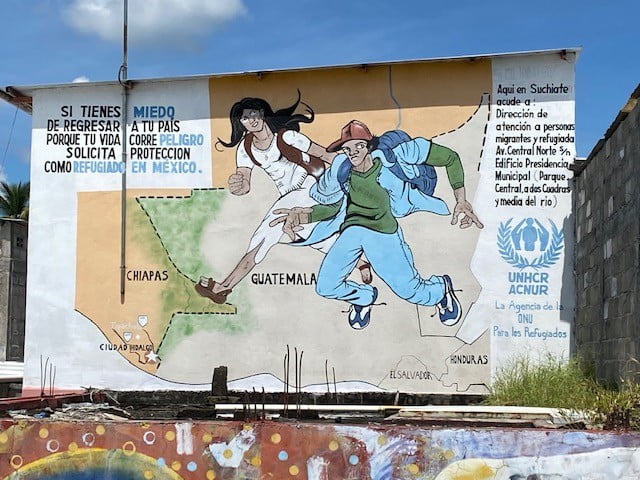
The picture to the right is another mural painted on the wall in southern Mexico that coaches migrants in what they need to say in order to be considered for asylum and moved into the next step of the process. The mural coaches- “If you are afraid of returning to your country because your life is in danger, request protection as a refugee in Mexico.”
The current situations in Haiti and Cuba have little to no effect on what is happening right now. The migrants we met from Haiti, Cuba, and Venezuela left their home countries years ago and have been living as legal and illegal immigrants in countries like Brazil, Colombia, Ecuador, and others for years.
They are leaving those countries to come to the US now because of the Biden Administration policies. They figure it may be now or never. And they are bringing babies with them. This ensures a free pass into the US when you get to our border. If you can get here alive.
Most of the migrants we met in McAllen, Texas and Del Rio, Texas came from Central American countries- El Salvador, Honduras, Guatemala, and Nicaragua. These migrants have a journey that is a mixture of planes, trains, busses, and taxis with very little foot movement necessary to make their way to the US border.
The migrants we met on this trip were from the Caribbean (Cuba and Haiti), Africa, and South America. These migrants must traverse the Darien Gap on foot to get here.
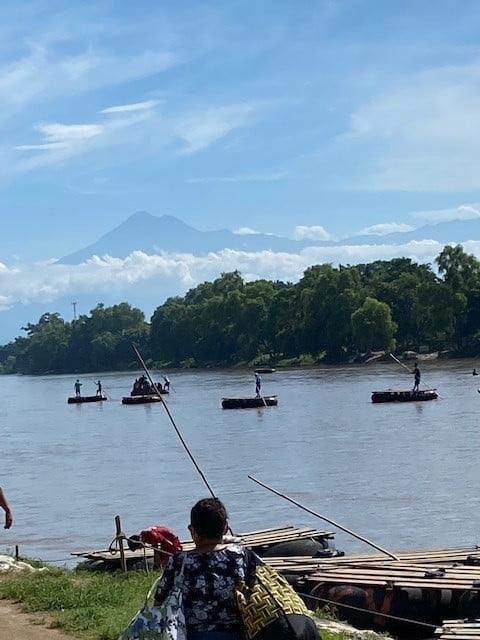
1 out of 10 die and disappear on this dangerous trek through the jungle. ATP traveled the migrant journey in reverse. We flew to Mexico City and then to Tapachula Mexico. We drove down to Ciudad Hidalgo, Chiapas and crossed the Suchiate River into Ayutla, Guatemala before returning to Tapachula. We then flew to Panama City and drove down the Pan American Highway to the Darien Province and canoed up the Chucunaque River to the Embera village of Bajo Chiquito. We then reversed course and returned to Panama City before flying to Cartagena Colombia for the final mission of the trip
Tapachula, Mexico.
Migrants are not only stalled in this southernmost town of Mexico as they are attempting to travel north, but they are also getting rejected by the US and Mexico and are sent back to Tapachula to await processing or encouraged to cross back into Guatemala. Under pressure from the U.S. government to contain illegal immigration, Mexico has been quietly flying thousands of undocumented migrants to the south of the country to expedite their departure. Mexico has now sent roughly 13,000 people from northern cities to its southern border on about 100 flights. The migrants put on the Mexican domestic flights were from all over the world and had either been detained under Mexican law or expelled from the United States under measures such as Title 42, a mechanism used to expedite removals in the pandemic under the Trump administration.
Since October of last year, U.S. agents have conducted 1,276,000 apprehensions or expulsions of migrants crossing the U.S. border illegally, including nearly 200,000 in July alone.
Tapachula has become accustomed to immigrants from Haiti and is used to seeing about 200-300 arrive each week to seek asylum. Starting in July, those numbers ballooned tenfold to 2000-3000 Haitian immigrants arriving in Tapachula. As stated above, these Haitians are not fleeing the current situation and unrest in Haiti, most of the Haitians left their homeland years ago and have been living in a third party country and are now on the move because of the Biden Administration policies. Migrants in Tapachula get stranded in the city for months. Many of them live on the streets and in packed tenements and converted migrant hotels.
While in Tapachula, we witnessed busses of Haitian migrants arriving from Guatemala and taken to a hotel that looked vacant. We initially visited the hotel to see if this might be a place that we could rent to offer shelter and schooling for the migrants stranded in the city. The security guard explained to us that the hotel was not vacant, but it was also not open to the public. It had been converted to a hotel for migrants only.
Dozens were packed to a room and few of them ventured out, fearing that the Mexican police might arrest them. You had to look closely to see the signs of thousands of migrants holing up in Tapachula. Some reported to us that they spent weeks inside, hiding from authorities, waiting for an opportunity to continue their journey north.
We tried to visit the detention center in Tapachula named Siglo XXI, which means “21st century” in Spanish. It is reportedly the largest detention center in Latin America and is a “secretive place off-limits to public scrutiny where … journalists aren’t allowed”. We were not allowed in, and we were not able to get our drone over it to capture any pictures.
For migrants who have just endured perilous journeys after escaping hazardous conditions in their own countries – all with the hope of eventually making it to perceived safety in the US – the psychological torture of being condemned to indefinite and criminalized limbo is not necessarily conducive to a desire for self-preservation.
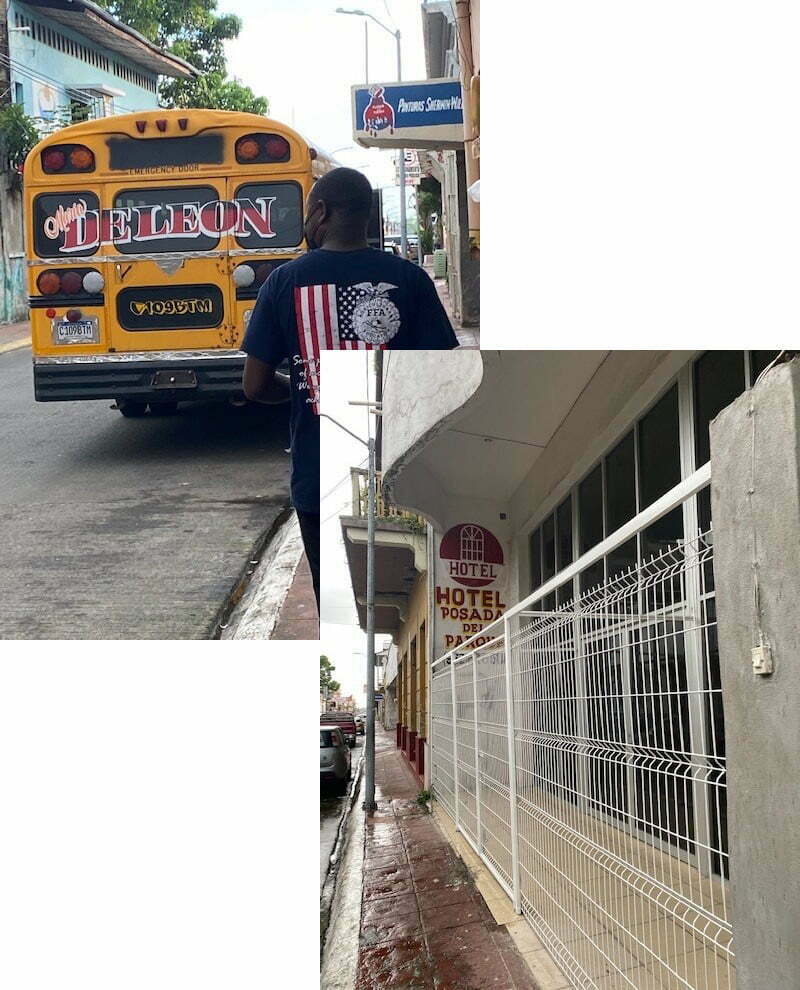
It’s why one of the first things they do is confiscate shoelaces.
More migrants are applying for asylum inside Mexico and abandoning their goal of reaching the United States. The Mexican state that has the highest percentage of the migrants seeking asylum is Chiapas, specifically Tapachula. That’s where they apply, and it’s where they must stay. By law, the person seeking asylum must remain in the Mexican state where they applied until the process is completed. This should take between 45 and 90 working days but often takes much longer.
A bottleneck has been created in Tapachula, where 71% of asylum seekers stay.
We believe that ATP can affect change here.
Darien Gap, Panama.
The other bottleneck we identified was in the Darien Gap of Panama. The Darien Gap is a treacherous, roadless, 60-mile stretch of jungle connecting Colombia with Panama. The vast majority of the more than 15,000 migrants who crossed the Darién Gap between January and May this year were Haitians and Cubans. Many Venezuelans have also taken the route this year, along with people from African countries, Indians, and Bangladeshis making their way to North America. People who make it through often report seeing the dead bodies of those who did not. An unknown number of migrants do not survive this dangerous passage, but the number is between 10%-14% that disappear or die.
The Darien Gap is a lawless, heavily forested jungle with steep, mountainous paths crisscrossing the jungle floor, and plenty of danger each step of the way. In June, 11,000 migrants entered Panama from Colombia—this is the highest figure recorded this year despite it being the rainy season, the most dangerous time to cross the Darien Gap.
The stories coming out of this hellish trek are straight out of nightmares. Bandits, rapists, thugs, dysentery, swollen rivers, dead bodies, lost children, and death everywhere. The migrants are using well-worn drug-smuggling routes that have now been converted to move human traffic for money.
1 in 10 of them do not get out alive. 100% of the adult women are raped and about 50% of the girls are raped.
We saw migrants emerge from the jungle in the small Embero village called Bajo Chiquito. This small village of a couple hundred Embaro Indians is completely overwhelmed with 1000 migrants each day flooding their village, half dead, confused and delirious.
In May, Doctors Without Borders/Médecins Sans Frontières (MSF) opened programs in Bajo Chiquito—the first village that migrants reach in Panama. Since then, their teams have provided medical and mental health care to more than 14,000 people who have crossed the Darien Gap. In July alone, their small team of 15—including medical, mental health, and logistical personnel—provided 6,000 consultations. Most people require treatment for trauma wounds, skin conditions, and foot injuries caused by the treacherous journey across wet, muddy, and steep terrain. The clinic dedicates a portion of its facility to pregnant women, mothers, and newborns “but it is not a hospital.”
The number of infants and babies carried on this trek is mind boggling. This phenomenon is a direct result of the current Biden Administration policy where a child provides free unfettered access to the United States for the family accompanying it.
Since 2017, the number of children crossing the Darien Gap has skyrocketed from 109 to 1,653 in 2020. This is fifteen times more children migrating through the Panama jungle in the last four years. The proportion of children among the migrant population through this jungle has dramatically risen in the past few years. Children accounted for only 2 per cent of all these migrants in 2017; but for more than 25 per cent in 2020. In the past 4 years, over 46,500 migrants have crossed the Darien jungle out of which 6,240 are children.
We saw children alone. We saw children with “families” and young men that were not their fathers.
But despite the risks, people continue to attempt the journey. By the end of July, around 8,000 migrants were waiting to start their trek through the Darién Gap. So far this year, Panama estimates about 49,000 migrants have come through the dangerous, jungle-clad gap. Officials estimate about 16% of them are children or youths.
Local officials estimate more than 10,000 migrants have massed recently in Necocli, a Colombian city that has become a bottleneck on the global migrant trail that winds through South and Central America, and on to Mexico and then the U.S. southern border.
Necocli residents say they have never seen so many migrants and city authorities have declared a “public calamity” because of water shortages caused by the additional demand from the migrants.
A common migrant route runs from the Ecuadorian border through Colombia to Necocli, where ferries carry people across the Gulf of Uraba to the even smaller border town of Capurgana — and then into the Darien Gap.
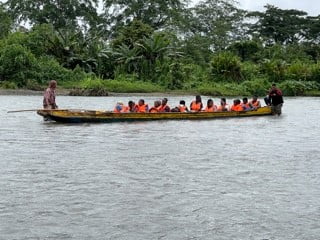
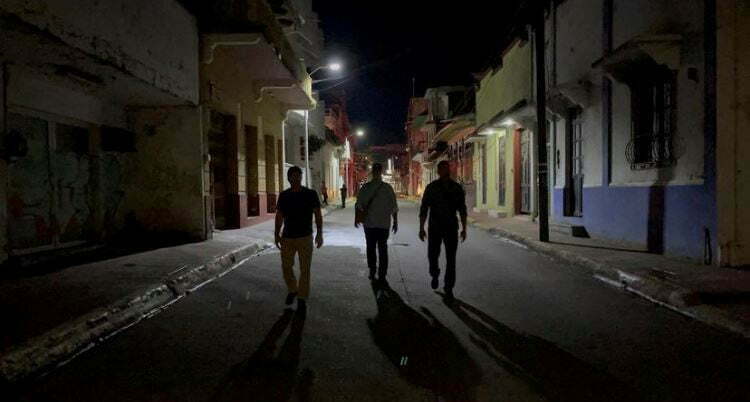
Once the migrants get to the other side of the Darien Gap, they spend a couple of days in Bajo Chiquito before getting loaded onto canoes and driven down river to a temporary holding center. We visited this holding center and personally witnessed the migrants getting loaded onto new commercial busses and getting driven the length of Panama and dropped at the Costa Rican border.
All in the dead of night. It is the only way the Panamanian government has figured out how to deal with this wave of humans. The “Controlled Flow” program between Panama and Costa Rica is the best they can do to control the flow so both countries don’t get overwhelmed. They pass the problem to the next country- Guatemala.
Colombia is largely doing the same.
Cartagena, Columbia.
Our team from ATP continued “upstream” and went to check out another place where we felt there was a bottleneck of migrants that were vulnerable for exploitation. Cartagena is the most visited city in Colombia. Tourists from all over the world arrive seeking its Caribbean charm- sun, breeze, sea, the small streets under little balconies… And of course, some of them are looking for sex.
The sex trade and sex procurement are issues that make headlines and conversations again and again. Even though it is not new or exclusive to this city – the same occurs in many destinations with tourism potential – the situation in Cartagena has unique elements.
The migrant women and children from neighboring countries is a crucial ingredient.
We can personally attest to the fact that sex work and exploitation are easy to find with a quick walk by the historic center. Every night, in front of the Torre del Reloj, the main entrance to the old city, women offer their bodies for sale with many of them underage.
Reportedly, sex workers earn between $30 and $50 “for a moment.” The women and girls we interviewed cost only $8 for the night, doing mostly anything the buyer desires.
Slightly more than a million people live in Cartagena, of whom 262,000 are poor, and around 40,000 live in extreme poverty. This dire need is invisible to the tourists that wander through the walled city, who can pay $70 dollars for a meal in one of the exclusive restaurants in the city, a sum equivalent to what a Colombian working for minimum wage makes in a week. This level of inequality has turned the city into a fertile ground for the sex trade, but measures to address it appear to be few, and fail to go beyond slogans or institutional positions.
Sex tourism in Cartagena is booming, and along with it, underage prostitution rings are confounding Colombian officials’ efforts to stop the trend. About 35,000 minors face sexual exploitation in Colombia, and 2,000 of those are in Cartagena, UNICEF reported earlier this year.
Many of these women and girls are from Venezuela.
Colombia hosts the largest Venezuelan diaspora of nearly 2 million people. In February 2021, the Colombian government announced a plan to provide a 10-year renewable regular migratory status to 1.7 million Venezuelans, most of them undocumented, living in the country.
The women and girls we talked with were smart, entrepreneurial, and ready to accept new opportunities.
We believe that ATP can affect change here.
The situation in all of these areas is dire. The human toll is incomprehensible. We’ve done our best to share with you the complexity of this migrant crisis from a macro level down to the micro level. Keep in contact with ATP and learn more about the personal stories we encountered on our trip.
We are developing plans to return to Tapachula and Cartagena to create something like we have in Cambodia and are looking at building in Iraq.
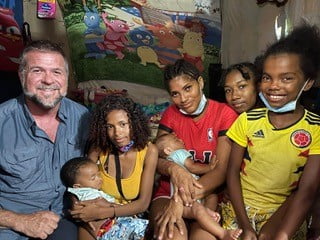
We want to establish a safe place where we can provide resources, healing, hope, education and equipping to the women and children affected by the tumult we see all around us. We want to reach the underserved and oppressed where they are now to provide them with the tools for self-reliance and living free. Our vision is to inspire hope for thousands and to bring the Good News to these dark places.
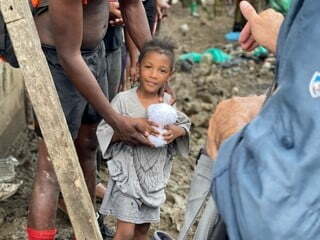
When we were in Bajo Chiquito, I at first felt a little foolish handing out our Lions and Lambs to children that sorely needed food, water, and medical care. But then I saw their faces and their reactions and realized that we were offering hope. A meal is consumed, medicine is digested, but the comfort from one of these small plush toys with its soothing music and prayers will endure much longer.
Behold, children are a heritage from the Lord, the fruit of the womb a reward.
– Psalm 127:3

Support Our Work.
Support our continued work on the Southern U.S. Border.

